Designing for the connection you actually have
A practical reading of devices, interrupted networks and player agency, with a test sequence for a more resilient first session.
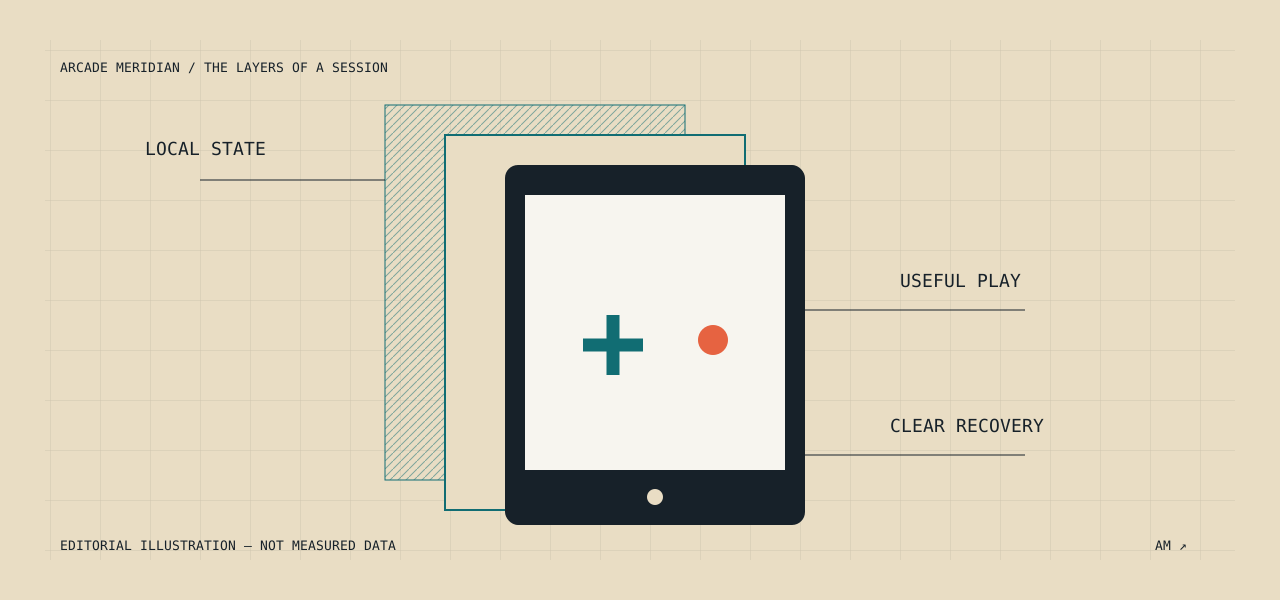
The network is part of the experience
Imagine a player opening a game during a short break. The device has some storage, an existing save and a connection that disappears before the menu finishes loading. What should remain possible? That question is more useful to a designer than a binary label such as connected or unconnected. It puts attention on the player’s next action and on the information the interface owes them.
The example is hypothetical. It is not a portrait of an average African player. Infrastructure differs within countries as well as between them, and the same person can move between conditions during a day. A responsible product brief keeps those conditions testable instead of turning a regional label into a specification.
Coverage is not a session
ITU’s 2026 release treats Internet use, network coverage and affordability as distinct indicators. That distinction matters editorially: a connectivity indicator cannot simply be renamed a game audience. It also matters in design. Being within network coverage says little about whether a particular download completes comfortably on a particular device.
Our inference is to translate broad infrastructure questions into observable product states. Can the opening screen explain what is happening? Does a missing connection block settings that could be changed locally? Is a second attempt safe after a timeout? These questions do not require a guessed national average, but their answers still need tests on devices and with people appropriate to the product.
Decide what belongs on the device
Android’s offline-first guidance describes local data as part of an application that remains useful through disconnection. For a game team, the design exercise is to classify features before deciding how to implement them. A solo tutorial, a competitive match and a shared inventory may have different trust and synchronization requirements.
Local availability should therefore be deliberate. A setting can usually display its last known value even when a leaderboard cannot refresh. Pending progress needs a clear status rather than a success message that is not yet true. The engineering details depend on the game, but the player-facing principle is stable: explain what is saved, what is waiting and what action is safe.
A four-state rehearsal
Use an example game with a short solo level and an optional account. Start with a fresh installation and document every step before the first input. Then disconnect after reaching the menu. Next, reconnect after making progress. Finally, close and reopen the application while a synchronization attempt is pending. This is a proposed test, not a claim about measured software.
- Fresh start: record all required downloads and which screens explain them.
- Connection lost: identify local actions that still work and messages that become misleading.
- Connection restored: check that retry does not duplicate a player action or erase a newer state.
- Application reopened: confirm that the interface describes the actual saved state.
Record the device model, operating system, game build and test conditions. A result without those details is difficult to reproduce. Keep observed failures separate from assumptions about why they happened; a slow screen may be a rendering issue rather than a network issue.
Payment is a separate journey
A successful game session does not establish that checkout works. Paystack’s channel documentation shows that support varies by country. It is a narrow capability reference, not permission to use a channel in every product or evidence that a particular audience prefers it.
For interface research, map the points at which the player leaves the game, authorizes an action and returns. Write distinct messages for pending, failed and completed outcomes. Do not grant a benefit solely because a browser returned to the game. This article does not provide an integration recipe or recommend bypassing a platform’s rules; it identifies a journey that deserves its own review.
Accessibility is not a later layer
Microsoft’s accessibility guidelines offer a reference for designing and testing accessible play. A connection warning that disappears too quickly can be hard to use regardless of bandwidth. A retry control that relies on color alone can hide an important distinction. Text expansion, input methods and readable status messages belong in the first-session test.
Give participants a real task and observe how they recover from an interruption. Ask what they think has been saved, then compare that answer with the application state. The mismatch is often more actionable than a general satisfaction score.
The limits of this framework
No device-distribution survey or regional latency benchmark was conducted for this article. The four-state rehearsal is a proposal for product work, not a certification. Its value is to make assumptions inspectable before they become frustrating experiences. For a more detailed packaging exercise, read Low-bandwidth distribution. For country-specific evidence and its limits, consult the market dossiers.
Sources & boundaries
Source review: . Undated sources are not assigned an invented publication date.
- Android Developers: Build an offline-first app ↗
Architecture guidance, not evidence of any country’s device mix or network performance.
Publication and review dates
Source publication: Undated. Source accessed and reviewed: 2026-11-17. Publisher: Android Developers.
- International Telecommunication Union: Facts and Figures 2026: release note ↗
Connectivity indicators are not counts of players or estimates of a game market.
Publication and review dates
Source publication: 2026-11-03. Source accessed and reviewed: 2026-11-17. Publisher: International Telecommunication Union.
- Paystack: Payment channels ↗
No endorsement, merchant eligibility assessment or claim about player preference. Store rules must be checked separately.
Publication and review dates
Source publication: Undated. Source accessed and reviewed: 2026-11-17. Publisher: Paystack.
- Microsoft: Xbox Accessibility Guidelines ↗
The guidance explicitly does not establish legal compliance or represent all players.
Publication and review dates
Source publication: 2023-06-08. Source accessed and reviewed: 2026-11-17. Publisher: Microsoft.
Original desk analysis; no interviews or field testing claimed. Corrections policy · Inspect Signals Atlas