The smallest useful download
A release worksheet for low-bandwidth distribution: separate essential assets, make interruptions recoverable and test the first playable session.
Define useful before defining small
Reducing a download is not automatically an improvement. A tiny initial installation that immediately asks for a large mandatory content pack may simply hide the true requirement. A useful release target describes a complete first experience: the player can open settings, learn the controls and finish a meaningful piece of play with a clear understanding of what comes next.
This article proposes a packaging worksheet for teams working with uncertain connectivity and device capacity. It does not assume those conditions are unique to Africa, and it contains no country-specific speed estimates. Regional conclusions need regional evidence. The engineering exercise begins with something a team can inspect directly: what its own build asks a device to do.
Draw the dependency boundary
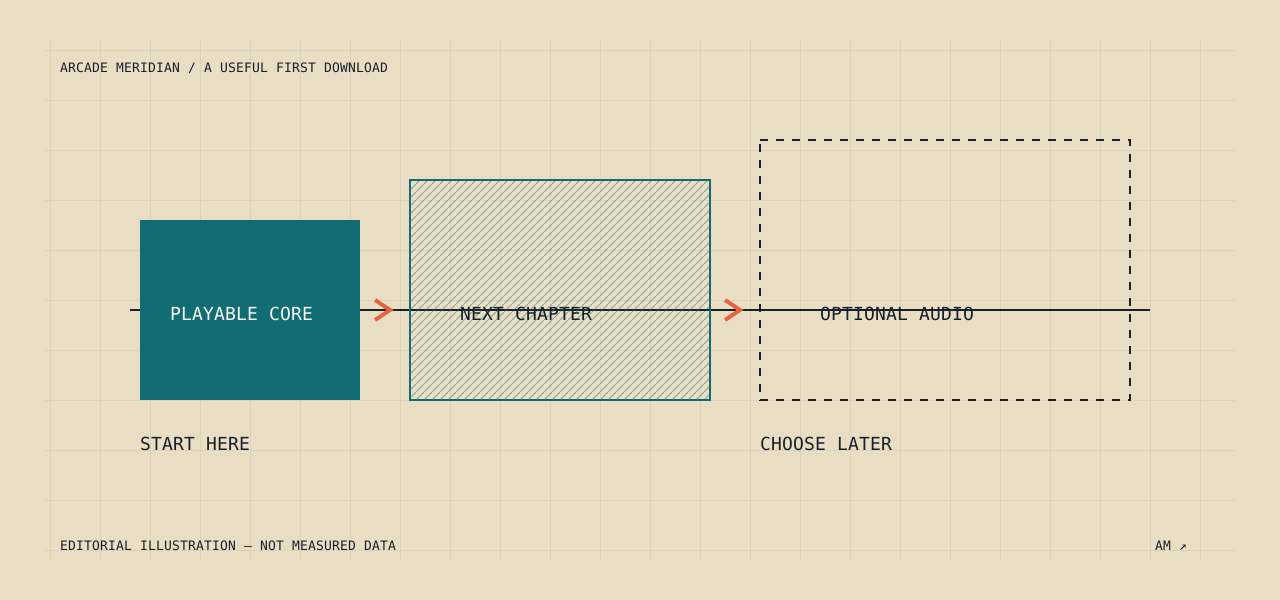
For an invented puzzle game, divide the content into a playable core, additional chapters, optional voice files and decorative extras. The core includes every asset needed to complete the opening session. An asset belongs in that core because the experience depends on it, not because the file happens to be small.
Then draw dependencies between the groups. If an optional chapter shares a texture with the opening level, moving that texture may break the supposed boundary. If a menu previews every voice pack, the interface may accidentally trigger downloads before the player chooses one. A packaging diagram is useful when it exposes these connections before they become release defects.
Delivery timing is a design choice
Play Asset Delivery documents install-time, fast-follow and on-demand modes. These establish available mechanisms on that platform. They do not prescribe a universal combination or guarantee a commercial result.
Our proposed worksheet assigns each group a reason for its timing. The playable core is needed immediately. A later chapter may be requested when a player approaches it. An optional voice pack should be an understandable choice. The same reasoning can be applied conceptually to another platform, but its actual tooling and rules must be checked separately rather than assumed equivalent.
| Example content group | Player-facing promise | Failure question |
|---|---|---|
| Playable core | Finish the opening session | Can a fresh install actually do this? |
| Next chapter | Continue after an explicit download | Is progress preserved while waiting? |
| Optional audio | Choose an additional voice pack | Can the player cancel and keep playing? |
| Cosmetic extras | Add optional presentation detail | Is storage use understandable? |
No sizes in this exercise are measurements. A real team should fill the worksheet from its own release artifact, not from an estimate copied from an unrelated title.
Treat interruption as an ordinary state
Android’s offline-first guidance provides a reference for keeping useful local data available when a connection is absent. The design implication here is that downloading, waiting, retrying and ready are different states. An interface should not blur them into one animated spinner.
Write the messages before polishing the animation. Explain whether the current session can continue, what is still missing and whether retrying will restart work. Let the player return to a safe screen. When the network returns, avoid unexpected downloads that contradict the choice they made while disconnected. These are proposed interaction principles; implementation details depend on the platform and the product’s integrity requirements.
Rehearse the update, too
The first install is only one release path. A returning player has saved progress, cached assets and expectations formed by the previous version. An update can change all three. Testing only a clean installation misses the moment when an old save meets a new content layout.
Keep an example save from the previous build. Update with sufficient storage, then repeat under a deliberately constrained test condition. Interrupt at a documented point and reopen. Record which assets are reused, which are requested again and what the interface says. Do not report a result as a general improvement until the comparison uses the same build inputs and measurement procedure.
Connect local tests to regional evidence carefully
ITU’s connectivity reporting distinguishes multiple dimensions of access. That supports a reason to ask nuanced questions; it does not supply a download budget for a particular game. A national or regional indicator cannot describe every household, device or session.
To make a regional claim, a release study would need a clear population, a sampling method, dates and conditions that match the claim. A handful of successful tests can show that a build works under those conditions. It cannot establish the prevalence of those conditions or the size of the addressable market.
A decision record worth keeping
The final output of this worksheet is a short record: what counts as a useful first session, which files it needs, when other files arrive, how interruption is handled and what was actually tested. The record gives designers, engineers and support staff a shared explanation of the release.
It also gives a reader a better question than whether a game is lightweight. Ask lightweight for which task, on which build, under which conditions. The mobile infrastructure feature extends that question to saved state and player agency. Our methodology explains why examples, observations and regional conclusions stay separate.
Sources & boundaries
Source review: . Undated sources are not assigned an invented publication date.
- Android Developers: Play Asset Delivery ↗
A platform capability is not a measured reduction in download abandonment.
Publication and review dates
Source publication: Undated. Source accessed and reviewed: 2026-11-17. Publisher: Android Developers.
- Android Developers: Build an offline-first app ↗
Architecture guidance, not evidence of any country’s device mix or network performance.
Publication and review dates
Source publication: Undated. Source accessed and reviewed: 2026-11-17. Publisher: Android Developers.
- International Telecommunication Union: Facts and Figures 2026: release note ↗
Connectivity indicators are not counts of players or estimates of a game market.
Publication and review dates
Source publication: 2026-11-03. Source accessed and reviewed: 2026-11-17. Publisher: International Telecommunication Union.
Original desk analysis; no interviews or field testing claimed. Corrections policy · Inspect Signals Atlas