The long road from a game to a player
Distribution is more than a storefront. Follow the decisions between a finished build, a usable download and a player’s first session.
Start at the other end
A game can be available and still be difficult to reach. A player may find its page, understand the premise and want to try it, yet stop when the download exceeds available storage. Another may install successfully but need a connection for an otherwise solitary first session. Neither experience is captured by a list of territories where a product is nominally offered.
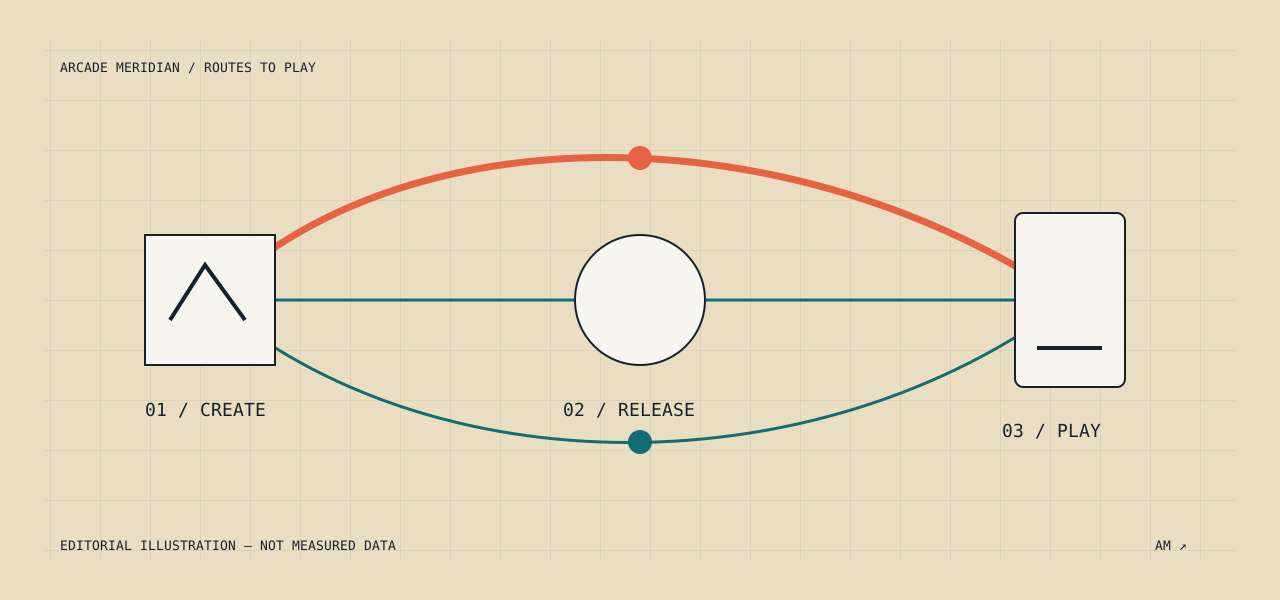
Our central proposition is that distribution should be described as a sequence of handoffs. Each handoff needs an owner, a failure state and a way back. This is an editorial framework for investigating releases, not a claim that all African players face the same obstacles. Country, platform, device, household and game type can change the sequence substantially.
Who owns each handoff?
A developer creates and maintains the playable work. A publisher may take responsibility for financing, promotion or release operations under an agreement. A storefront gives the player a place to discover and obtain a game. A distributor or aggregator may coordinate access to multiple titles or channels. These are useful role descriptions; a particular company can perform several roles, and a contract can allocate them differently.
Direct work with a developer can shorten the path for resolving a build problem, but it also leaves more coordination with the releasing team. Working through a publisher can consolidate responsibilities, while introducing another approval step. Aggregation can simplify a catalogue relationship without automatically solving localization, support or compatibility. These are tradeoffs to investigate, not a ranking of routes.
The practical question is not how many intermediaries a release has. It is whether a reader can identify who changes the build, who updates the listing and who answers the player when those two disagree. A diagram with named responsibilities is more informative than an impressive list of distribution partners.
A demo is a release decision
Steamworks documents demos as separately configured applications. That makes the demo a useful concrete example: trying a game is itself something a team has to package and maintain. The documentation establishes the mechanism, not the probability that it will attract buyers in any particular country.
Consider an invented independent puzzle game. Its team wants to offer one short chapter before purchase. A useful review asks whether the trial includes the actual input settings, whether its text is translated to the same standard, and whether a player can understand what is missing. If the demo only works smoothly on a powerful machine, it may misrepresent the full product’s intended audience. This example is a design exercise, not an observed commercial release.
Separate the store from the payload
Play Asset Delivery supports different timing for asset downloads. That is evidence that delivery can be staged. It does not tell us which stage is best for a particular game or region.
For the invented puzzle game, a release worksheet could separate the executable, the first chapter and optional voice files. The team would then identify which parts are essential before play begins. Moving an essential file into a later download simply moves the waiting screen. A useful experiment records the time to a playable state and whether an interrupted download can be understood and resumed.
| Handoff | Question to resolve | Evidence to retain |
|---|---|---|
| Listing to install | Does the listing explain the actual requirements? | A dated listing and tested device |
| Install to first play | What else must be fetched? | A fresh-install observation |
| Update to resume | Can existing progress still be loaded? | A saved-state upgrade test |
Put local examples in proportion
Maliyo’s catalogue gives a concrete starting point for examining games made in Lagos. It establishes a creative example, not a census of Nigerian production. A reader should resist converting a few visible studios into a national genre preference or assuming that the location of a developer identifies the location of its audience.
For an actual distribution investigation, begin with one named title and one release channel. Record the observed store page, the device used, the date, the route to installation and the boundary of the test. Then repeat under a deliberately different condition. Comparison becomes meaningful when the procedure is visible and its limits are preserved.
What this account cannot tell you
This article contains no player survey, contract inspection or download-performance dataset. It cannot estimate demand or recommend a commercial intermediary. Its contribution is a way to ask better release questions: where does responsibility move, which assumptions become visible to the player, and what evidence would show that the handoff works?
Continue with the low-bandwidth distribution worksheet for a staged-download example, or compare the evidence boundaries in our Nigeria dossier. The Signals Atlas keeps individual observations linked to their sources so that the interpretation can be challenged rather than inherited as fact.
Sources & boundaries
Source review: . Undated sources are not assigned an invented publication date.
- Valve / Steamworks: Demos ↗
Availability of demos does not establish discoverability, conversion or demand.
Publication and review dates
Source publication: Undated. Source accessed and reviewed: 2026-11-17. Publisher: Valve / Steamworks.
- Android Developers: Play Asset Delivery ↗
A platform capability is not a measured reduction in download abandonment.
Publication and review dates
Source publication: Undated. Source accessed and reviewed: 2026-11-17. Publisher: Android Developers.
- Maliyo Games: Studio and game catalogue ↗
A studio catalogue establishes examples, not national revenue, employment or audience share.
Publication and review dates
Source publication: Undated. Source accessed and reviewed: 2026-11-17. Publisher: Maliyo Games.
Original desk analysis; no interviews or field testing claimed. Corrections policy · Inspect Signals Atlas