Audit a distribution claim before repeating it
A practical evidence worksheet that separates a platform capability, a particular release and an observed outcome, with a worked fictional example.
Start with the verb in the sentence
“Supports,” “uses” and “improves” can appear close together in a distribution story, but they make different promises. A platform supports a mechanism. A named release uses it. A measured outcome improves under specified conditions. Finding evidence for the first sentence does not establish the other two.
This distinction matters when a studio, editor or researcher assembles a short account of how a game reaches people. Platform documentation is often easy to find; title-level configuration and independent outcome measurements are harder. The gap should remain explicit. The method below is original desk analysis with a fictional release exercise, not a report of tests we performed on a commercial game.
Three records, three different jobs
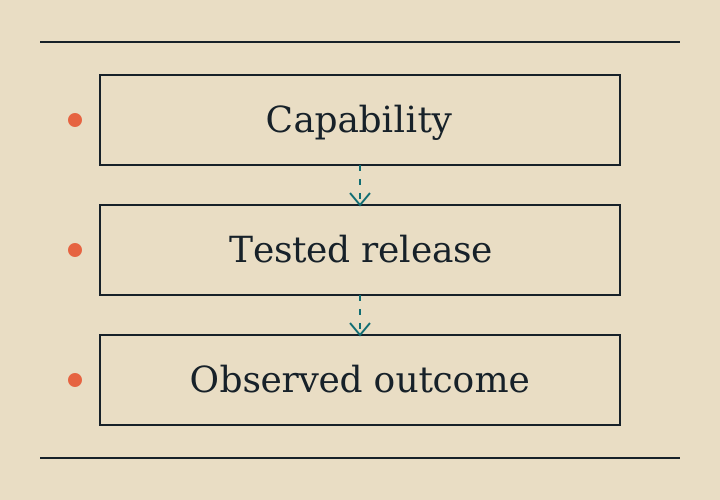
A capability record identifies a documented option and its platform boundary. A release record identifies the particular build and configuration being examined. An outcome record describes the observation, population and method supporting a result. The original diagram above keeps these records apart.
Google’s Play Asset Delivery documentation identifies install-time, fast-follow and on-demand asset delivery. That supports a statement about available mechanisms. It does not, by itself, show that an unnamed game uses any particular mode or that a smaller initial download improves its retention.
Steamworks’ demo documentation describes a demo as a separate application identity associated with a full game. It provides another capability example. A researcher would still need release-specific evidence to describe a particular demo’s configuration or its results.
Check the two platform references
Play Asset Delivery is published by Android Developers / Google; Demos by Valve / Steamworks. Both were accessed and reviewed on 17 November 2026. Original publication dates are not established in this register. Their scope is platform capability, not comparative performance or regional demand.
A fictional release note, examined line by line
Suppose an invented puzzle game announces: “Our lighter first download makes play easier on unreliable connections.” Before repeating the sentence as a finding, split it into questions.
“Lighter” needs a comparison. Is the claim about the store’s displayed size, downloaded bytes, installed storage or the material required before a usable first session? A smaller executable can coexist with a mandatory second download. The baseline and the measurement point should be named before any reduction is calculated.
“First” needs a starting state. A clean installation, an update and a returning session can use different cached assets. An editor should not combine their timings. “Easier” needs an observable task. Does the player reach a controllable scene, understand an interruption, or resume without losing progress? A general adjective should not conceal three different tests.
“Unreliable connections” needs a described condition. An intentional disconnection during a rehearsal is not a survey of networks in a country. It can reveal a recovery defect in that build. It cannot establish how often the condition occurs among players.
An evidence worksheet a small team can actually use
Use one row per claim. Keep the observed material beside the interpretation rather than hiding it in a footnote.
| Proposed statement | Evidence needed before reporting it | If the evidence is missing |
|---|---|---|
| This platform offers staged assets | A dated primary capability document | Describe the mechanism as unverified |
| This build stages its optional audio | The identified build and observed/configured delivery path | Keep it as a test question |
| The opening task required fewer bytes | Comparable measurements with the same task boundary | Do not publish a reduction |
| Players understood interruption better | A defined study, participants, method and results | Describe a design proposal, not a finding |
This worksheet is a proposed editorial method. It does not certify a product. Its value is that another reader can see which verb the evidence permits and what would have to change before a stronger verb becomes justified.
Rehearse an interruption without inventing a result
For the fictional puzzle game, define a first session as opening settings, completing the tutorial and finishing one puzzle. Name the build, device, operating system and starting cache state. Record the material needed for that task, including downloads triggered after launch.
Next, choose an interruption point that another tester can repeat. Note the actual message and available actions. On reconnection, record whether the task resumes, restarts or requires another choice. Preserve an unexpected outcome rather than retesting until a preferred result appears. No timings or success rates are supplied here because this publication has not run that experiment.
Android’s offline-first guidance distinguishes useful local reads from network-dependent work. It supports a reason to inspect what remains available during disconnection. Whether a specific game preserves progress or correctly reconciles state remains a release-specific question.
Keep negative evidence at the right scale
If one rehearsal fails, report that failure with its conditions. Avoid changing it into “this platform fails on mobile networks.” Conversely, if the rehearsal succeeds, do not claim the game works for everyone. A small, reproducible observation can be actionable without being representative.
Missing information also deserves an exact label. “No source in this collection” means the collection is incomplete. “The cited document does not support this statement” is a narrower editorial judgment. “We could not retrieve the page” concerns access at a particular time. None of these is automatically proof that a mechanism or activity does not exist.
This is why Evidence Atlas exports keep limitations attached to claims. Removing the caveat while retaining the source URL creates a more authoritative-looking record with less information. A portable reading list should carry enough context for the next reader to avoid that loss.
Leave a revision trail, not a refreshed date
When new evidence arrives, record what changed: a URL moved, a platform definition changed, a build was replaced, or a conclusion no longer follows. Keep source publication, access and article dates distinct. A working URL on today’s date is not proof that its text still supports yesterday’s interpretation.
Our smallest useful download worksheet helps define the release task. The connectivity evidence reading explains why population measures require a different record. Together they support a modest editorial habit: report the narrow result that can be retraced, and leave the larger claim open until its own evidence exists.
Sources & boundaries
Source review: . Undated sources are not assigned an invented publication date.
- Android Developers: Play Asset Delivery ↗
A platform capability is not a measured reduction in download abandonment.
Publication and review dates
Source publication: Undated. Source accessed and reviewed: 2026-11-17. Publisher: Android Developers.
- Valve / Steamworks: Demos ↗
Availability of demos does not establish discoverability, conversion or demand.
Publication and review dates
Source publication: Undated. Source accessed and reviewed: 2026-11-17. Publisher: Valve / Steamworks.
- Android Developers: Build an offline-first app ↗
Architecture guidance, not evidence of any country’s device mix or network performance.
Publication and review dates
Source publication: Undated. Source accessed and reviewed: 2026-11-17. Publisher: Android Developers.
Individual claim records: Design a useful state before the network responds · The first install need not contain every asset · Treat a demo as its own release
Continue the investigation
Original desk analysis; no interviews or field testing claimed. Corrections policy · Inspect Signals Atlas